| 2.2. Development in MeVisLab | ||
|---|---|---|
 | Chapter 2. The Nuts and Bolts of MeVisLab |  |
| 2.2. Development in MeVisLab | ||
|---|---|---|
| | Chapter 2. The Nuts and Bolts of MeVisLab | |
In MeVisLab, development can be done on three levels:
Visual level: Programming with “plug and play”: Individual image processing, visualization and interaction modules can be combined to complex image processing networks using a graphical programming approach.
Scripting level: Creating macro modules and applications based on macro modules: Python scripting components can be added to implement dynamic functionality on both the network and the user interface level.
C++ level: Programming modules: New algorithms can easily be integrated using the modular, platform-independent C++ class library.
In addition, the abstract, hierarchical MeVisLab Definition Language (“MDL”) allows designing efficient graphical user interfaces, hiding the complexity of the underlying module network to the end user.
From a workflow point of view, an application development would look as follows:
Connect existing modules to networks.
Develop new modules if necessary.
Build user interface (GUI).
Build macro modules to recycle complex functionality.
Use scripts to control networks, GUIs, and macros.
Build installer (only with a special ADK license which is only available for very close partners of MeVis).
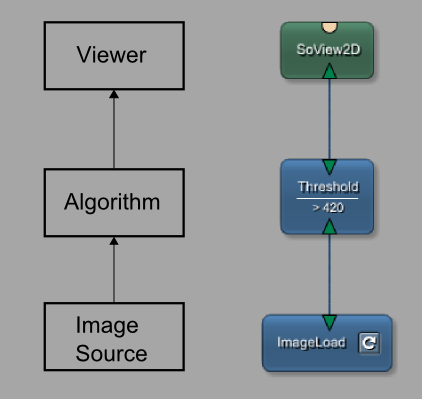
In MeVisLab, the algorithms are visualized as a network of modules (graphs). In a minimalist approach, an image processing pipeline would consists of an image source, some algorithm/image processing step in the middle and a viewer for displaying the output. This pipeline is mirrored in the MeVisLab GUI.
Modules can be connected in various ways which will be described in the following paragraphs.
© 2023 MeVis Medical Solutions AG
| |  | |
| Chapter 2. The Nuts and Bolts of MeVisLab |  | 2.3. MeVisLab Modules |